
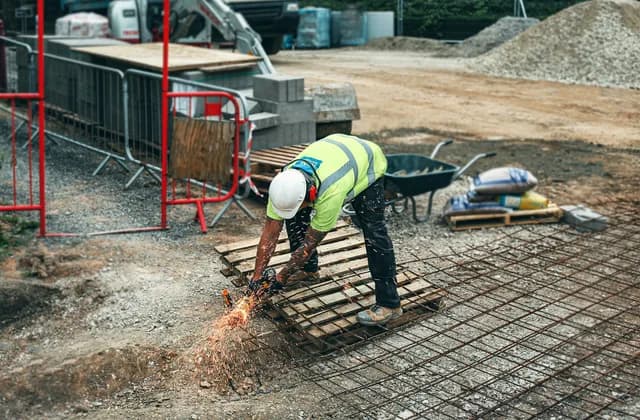
Three site adverts, three different gates. A Houston contractor wants “general labourers, OSHA 10 preferred, own boots and hard hat”. A London groundworks firm wants “CSCS Green card, CIS, 7am start”. A Port Harcourt builder wants “site labourers, daily pay, trade test an advantage”. Nobody is asking for a licence, because labouring does not have one. They are asking whether you can walk through the gate on Monday morning without the site being in breach of something.
That gate is different in each market, and so is how you get paid and taxed once you are through it. What follows is the market-by-market version, then the parts that are the same everywhere: what the job actually involves, the tickets that move you up, how day rates work, and how to write an application a site manager reads in five seconds.
United States: no card nationally, but OSHA 10 is law in several states
There is no federal card for construction workers and no licence for labouring. What exists is the OSHA Outreach Training Program, the 10-hour and 30-hour construction courses, delivered by authorised trainers. The 10-hour is aimed at workers, the 30-hour at supervisors, and neither is a certification of skill: they are hazard-awareness training, and the card has no expiry printed on it, though many employers and states treat it as needing renewal every few years.
Where it is required, it is required by state or city law rather than by OSHA itself. New York State attaches it to many publicly funded projects and New York City goes much further with Site Safety Training cards under Local Law 196; Nevada requires it for construction workers; Connecticut, Massachusetts, New Hampshire, Missouri, Rhode Island and Pennsylvania have requirements tied to public works or to construction generally. The list and the details change, so check your own state. Where the law is silent, large contractors usually require it anyway.
What the employer must provide, and what you bring
OSHA standards put the duty on the employer: hard hat, eye protection and most other personal protective equipment must be provided at no cost to you, with a narrow exception for ordinary safety-toe boots and prescription safety glasses, which employers may require you to own. Fall protection is required in construction above six feet, trench protective systems above five feet, and both are the employer’s responsibility to plan and supply. A site that tells you to buy your own harness is telling you what kind of contractor it is.
Pay is set by the local market except on public works, where the Davis-Bacon Act and state equivalents require the locally prevailing wage and fringe benefits, which are usually well above the private rate for the same work. Overtime at one and a half times applies beyond forty hours in a week. Union routes through the labourers' training programmes offer structured progression and benefits; non-union work is more common in the South and West.
US openings on Hirovo are grouped by county: construction jobs in Harris County (Houston), Maricopa County (Phoenix) and Clark County (Las Vegas) are three of the busiest construction markets.
Create a free Hirovo profile, add construction work to your skills and set your location. New posts near you appear on their own, so you hear about the next project starting rather than the one that just filled.
Create a free account →United Kingdom: the CSCS card, the CITB test and CIS tax
No law says you must hold a CSCS card, but nearly every commercial site and major contractor requires one, so in practice it is the gate.
| Step | What it is | Roughly how long |
|---|---|---|
| Level 1 Award | Health and Safety in a Construction Environment, a one-day course and assessment, or an approved equivalent. | One day |
| CITB HS&E test | The operatives version of the Health, Safety and Environment test, taken at a CITB test centre. Must be within the last two years when you apply. | 45 minutes, booked in advance |
| CSCS Green Labourer card | Applied for after the award and the test. Proves you have basic health and safety knowledge; it is not a skills qualification. | Days to a couple of weeks |
| Site induction | Done on the first morning by the principal contractor: site rules, hazards, welfare, emergency arrangements. Legally required under CDM. | One to two hours |
Once you are on site, the framework is the Construction (Design and Management) Regulations, and the paperwork you will meet daily is the risk assessment and method statement, the RAMS, which you sign to say you have understood the safe system of work for your task. Manual handling training is the employer’s duty; asbestos awareness is required for anyone who may disturb asbestos-containing materials, which on refurbishment work means most people. The Working Time Regulations cap the average week at 48 hours with an opt-out you can decline.
PAYE, agency or CIS
Three payment routes, and the difference is larger than the day rate suggests. Direct PAYE employment brings holiday pay, sick pay and a pension. Agency work brings equal pay after 12 weeks in the same role under the Agency Workers Regulations. CIS self-employment means the contractor deducts 20 percent at source, or 30 percent if you have not registered with HMRC, and you settle through self-assessment with a refund usually due; there is no holiday or sick pay at all. Convert every offer into an annual figure that includes the weeks you will not work before you decide which is better.
UK openings on Hirovo are listed by county or borough: see construction jobs in Greater London, Hertfordshire and North Yorkshire.
Nigeria: the trade test, the subcontractor and the site you should check
Nigeria has no card scheme for construction workers. Labourers are hired daily on site or through subcontractors, and the recognised proof of competence for skilled trades is the Federal Ministry of Labour and Employment trade test, graded III, II and I. For a labourer it is not required, but holding grade III in a trade signals that you are on your way somewhere and is worth having.
Safety practice varies enormously. Large contractors on oil and gas, banking, telecoms and multinational projects run proper inductions, supply personal protective equipment, hold toolbox talks and enforce harness use at height; smaller projects may supply nothing and expect you to arrive with your own boots and helmet. The Factories Act and the Labour Act place duties on employers, and the Employee Compensation Act provides for compensation for workplace injury through the Nigeria Social Insurance Trust Fund, but enforcement is uneven. Before your first day, ask two questions: who is the main contractor, and does the site do an induction. A project that cannot answer the second is one where an injury will be your problem alone.
On pay, the divide is again formal against informal. Formal employers pay monthly through payroll, remit pension contributions and give written terms within three months as the Labour Act requires. Site labouring is more often daily-paid in cash, arranged through a gang leader or subcontractor. Daily work is legitimate and is how most people start; treat it as a trial, ask what the rate is per day before you start rather than at the end of the week, and move towards the contractors who write things down.
Nigerian openings on Hirovo are grouped by local government area: construction jobs in Kosofe, Lagos, Port Harcourt and Sabon Gari (Zaria), Kaduna.
What a labourer actually does
The job title hides a wide range, and the part of the site you land on decides what you learn.
- Groundworks. Drainage, foundations, kerbs, concrete. Wet, heavy, weather-dependent, and the best place to learn levels and setting out. Often the highest labouring rates.
- Trade support. Mixing and carrying for bricklayers, plasterers, steel fixers or carpenters. The route into a trade, because the gang teaches you while you work.
- Clearing and logistics. Materials distribution, waste segregation, keeping routes clear, unloading deliveries. Less glamorous, but the logistics team knows the whole site and often becomes supervision.
- Traffic marshal or banksman. Directing vehicles, plant and lifts. Requires a ticket and pays more than general labouring; the person the site cannot start without.
- Demolition and strip-out. Refurbishment work, dusty, with asbestos awareness essential and often additional health surveillance.
- Fit-out and finishing. Indoor, drier, later in the project. Suits people moving towards a finishing trade.
If you are new, take whatever gets you onto a site with a proper induction, then decide which gang you want to end up in. If you are experienced and stuck at the base rate, the moves that pay are tickets, groundworks and traffic marshalling, then an apprenticeship or NVQ into a trade.
Day rates, weather and how the pay is actually built
Construction pays by the day or the hour, and both hide the same risk: the days you do not work.
A day rate is not a salary. Rain, a delayed delivery, a scaffold that is not signed off, or the end of a phase can cost you days. Ask how long the project runs and whether there is work after this phase, and price the answer into the rate.
Overtime and weekends are contractual outside the US. The United States requires one and a half times beyond forty hours for employed workers. The United Kingdom has no statutory overtime premium, and Nigeria leaves it to the contract. If the Saturday rate is not written down, it does not exist.
Travel, parking and lodging. On a city-centre project, parking can cost a meaningful part of a day rate. Working away should come with lodging money. Ask for both as figures.
Boots, hard hat and tickets. Personal protective equipment is the employer’s duty in the US and the UK, with safety boots the usual exception you buy yourself. A contractor that funds your next ticket is giving you a pay rise that follows you to the next job.
Nobody legitimate charges you to start on a site. Not a “site pass” fee, not a PPE deposit, not an agency registration fee, not a payment for a card or test made to a recruiter rather than to the awarding body or test centre, and not money refunded after your first month. In the UK you book the CITB test and apply for the CSCS card yourself, and the fees are modest and published; in the US you pay an authorised OSHA Outreach trainer directly; in Nigeria the trade test fee goes to the Ministry of Labour. A middleman collecting that money is not part of the process. And never hand over your ID, bank details or a photograph of yourself holding your ID before a verified written offer from a contractor whose company and site you have checked.
An application a site manager can read in five seconds
Whoever reads your application has a gang short of a man at 07:00 tomorrow. They want to know whether you can walk through the gate. Put that in the first four lines.
- Line one: your cards, with dates. UK: CSCS card type and expiry, CITB test date, asbestos awareness. US: OSHA 10 or 30 and the year, plus any state or city card such as New York’s SST. Nigeria: trade test grade if you hold one.
- Line two: your tickets. Abrasive wheels, harness and working at height, PASMA, IPAF, traffic marshal or banksman, telehandler or dumper. Name them; these are what a site is short of.
- Line three: the work you have done, by type. “Groundworks and drainage, 2 years; trade support to a bricklaying gang, 18 months” tells a manager where to put you. Contractor names alone do not.
- Line four: transport and start times. Whether you drive, whether you have your own transport to a site with no bus route, and that you can be there for a 07:00 start.
- Line five: availability and duration. Weekends, nights on rail or road projects, working away, and how long you are available for.
- Finally, a site or gang supervisor who will give a reference. Construction runs on word of mouth, and the reference that counts is from someone who watched you work, not from an office.
Weather, seasons and staying employed all year
Construction work is seasonal in a way that catches new labourers out, and the seasonality is different in each market. In the United Kingdom and the northern United States, groundworks, roofing and external finishes slow down in winter, and a wet fortnight can cost a day-rate worker a week’s pay. In Texas, Arizona and Nevada the difficult season is summer heat, with early starts, heat-illness rules in some states and afternoon stoppages. In Nigeria the rainy season slows earthworks and concrete pours in much of the south.
The labourers who work all year do three things. They move indoors when the weather turns: fit-out, strip-out, refurbishment and internal finishing carry on when groundworks stop, and a labourer who has worked with a plastering or drylining gang has somewhere to go in January. They hold tickets that are in demand regardless of season, particularly traffic marshal, harness and mobile tower tickets, since those roles exist on every phase. And they keep the relationship with two or three agencies or gang supervisors rather than one, because the call goes to the person the supervisor remembers.
Ask about weather before you accept a day rate. Some contractors pay a reduced rate or a guaranteed minimum for a rained-off day, some pay nothing at all, and the difference over a winter is substantial. Ask what happens if the site is stopped after you have travelled to it, since a two-hour round trip for nothing is a real cost. And ask how long the phase you are joining runs, because the honest answer tells you whether you are being hired for four weeks or four months.
One more thing worth saying plainly: heat and cold are safety issues, not just comfort. Several US states have heat-illness prevention rules requiring water, shade and rest breaks, and OSHA pursues heat cases under the general duty clause. In the United Kingdom there is no maximum working temperature, but employers must assess the risk and provide suitable arrangements. A site that will not stop for weather that is genuinely dangerous is a site that will cut corners on other things.
Where construction jobs are listed on Hirovo
Listings are grouped by country, then region, then county or local government area, so you can search sites you can actually reach for a 07:00 start.
- United States: Harris County · Maricopa County · Clark County · all locations in Nevada
- United Kingdom: Greater London · Hertfordshire · North Yorkshire · all locations in England
- Nigeria: Kosofe, Lagos · Port Harcourt · Sabon Gari, Kaduna · all locations in Kaduna State
Summary
Labouring has no licence, but it has a gate: a CSCS card in the United Kingdom, OSHA 10 in the states that require it, and a proper site induction in Nigeria. Get the one your market uses before you apply; it is cheap, it takes days rather than months, and it moves you from maybe to Monday.
After that, the money is in the tickets and the days. Add the ticket the project is short of, ask how long the phase runs, get the weekend rate in writing, and put your cards, tickets and transport in the first four lines. The site manager who is a man short reads those lines and calls you first.