
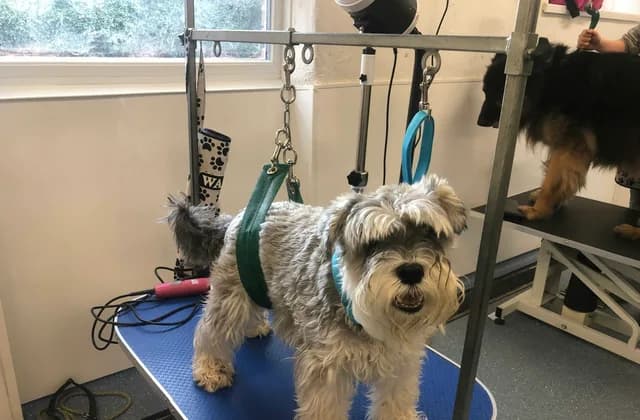
Dog grooming looks simple from the outside: a bath, a trim, a bow on the collar. In practice, choosing a dog groomer means handing your dog to a stranger for an hour or more, often with sharp tools, water and heat involved. Quotes can look far apart, and the formats differ too: a salon, a mobile van outside your door, a groomer who comes into your home, or a self-wash station where you do it yourself.
This guide is for dog owners in the United States and the United Kingdom. It explains the main grooming formats, how to choose a groomer you can trust, the health and safety questions worth asking, and what sets the price. Where the rules differ between the two countries, there are separate notes.
Dog grooming formats: salon, mobile, in-home or self-wash
Each format suits different dogs and different owners. The right one depends on how your dog copes with travel, other dogs, noise and being handled.
| Format | What it usually involves | Worth asking |
|---|---|---|
| Salon | You drop the dog off; it may wait with other dogs before and after the groom. | How long will my dog be there, and how is it dried and supervised? |
| Mobile van | A van parks outside your home and the groom happens inside it, usually one dog at a time. | Where does the van get water and power, and can my dog take breaks? |
| In-home groomer | The groomer comes into your home and works in a bathroom or kitchen. | What space and surface do you need, and what do you bring? |
| Self-wash station | You wash and dry the dog yourself with a tub, shampoo and dryer provided. | Is help on hand, and what is included in the session? |
A mobile van or in-home groomer often suits nervous, older or reactive dogs, because there is no car journey and no waiting room. A salon may suit a confident dog that needs a full breed cut. A self-wash station can work for a quick bath between professional grooms, but it does not replace a groomer for clipping, de-matting or nail work if you are not confident doing them.
How to choose a dog groomer you can trust
US: most states do not license dog groomers. Local business rules may still apply, so check with your local authority if you want to know what is required where you live.
UK: in England, dog grooming is not a licensable animal activity, so there is no licence to check.
In both countries, training courses and certificates exist, but they are voluntary. Anyone can call themselves a groomer. That puts the checks on you. Ask about:
- Training: where they learned, and what they trained in.
- Experience: how long they have groomed, and how often they work with your breed and coat type.
- Insurance: public liability insurance, and “care, custody and control” cover for animals in their care. Ask to see proof.
- Handling: how they deal with a dog that is anxious, wriggles or snaps, and whether they will stop and call you.
- Drying: whether drying is done by hand and supervised.
A short visit or meet-and-greet before the first groom is a good sign. It lets the groomer see your dog’s coat and temperament and lets you see how they treat animals.
Red flag: offering to sedate your dog
Sedation is a veterinary decision only. A groomer who offers to sedate a dog, or suggests giving it something to calm it down, is a red flag. If your dog cannot be groomed safely awake, talk to your vet about what to do.
Health, vaccinations and sensitive dogs
Many salons ask for proof that your dog’s vaccinations are up to date. In the US, rabies vaccination is commonly required. In the UK, requirements vary between groomers, so ask what they need before you book.
Tell the groomer everything that could affect the groom. That includes:
- Allergies, including to shampoos or products.
- Skin problems, lumps, wounds or sore spots.
- Age, and any heart, breathing or joint issues.
- Any history of biting or snapping, even if it was long ago.
- Places your dog does not like being touched, such as feet, ears or tail.
Flat-faced breeds such as pugs, bulldogs and shih tzus, and older dogs, are more sensitive to heat and stress. For these dogs, ask how drying is done. Hand drying under supervision is the safer approach; heated cage dryers left unattended are a known heatstroke risk. Ask whether your dog will get breaks, and how long the whole groom will take.
If your dog is injured: photograph the injury and see a vet straight away. Then contact the groomer in writing with the photos. In the UK, the Consumer Rights Act 2015 says a service must be carried out with reasonable care and skill.
Posting a job on Hirovo is free. Say your dog’s breed, size and coat, what you want done, whether you prefer a salon, mobile or in-home groom, and anything the groomer should know about health or temperament. Groomers nearby can apply or message you in the app. You compare them and decide.
Post a free job →What sets the price of dog grooming
A single figure found online cannot price your dog. These are the items that move the number:
- Size and breed: a large double-coated dog takes far longer to wash and dry than a small short-haired one.
- Coat type and condition: long, curly or thick coats need more work, especially if they have not been brushed.
- Matting: de-matting takes time; severe mats may mean clipping short instead.
- Services chosen: bath, breed cut, puppy cut, sanitary trim, de-shedding, nail trim, ear cleaning and teeth brushing can be priced separately or bundled.
- Temperament: an anxious dog may need more breaks and more time.
- Format: a mobile van or in-home visit includes travel and one-to-one time; a salon may run several dogs at once.
- How often you book: a dog groomed regularly is usually quicker to groom than one seen once a year.
What each package includes
Package names are not standard. One groomer’s “full groom” may include nails and ears; another may charge for them separately. Ask what each package includes, item by item, and compare two or three written quotes for the same dog and the same services.
Matted coats
Severely matted coats may need to be shaved short for the dog’s welfare. Brushing out tight mats can be painful and can tear the skin. A good groomer checks the coat first and explains this before starting, not after. Agree in advance what will happen, and what it will cost, if matting turns out worse than expected.
Questions to ask before the first dog grooming visit
- What training do you have, and how much experience with my breed?
- Can I see proof of your insurance, including cover for animals in your care?
- Which vaccinations do you need to see?
- How do you dry dogs, and is anyone with my dog the whole time?
- How do you handle an anxious dog, and when would you stop and call me?
- Exactly what does this package include?
- What happens if the coat is matted?
- How long will the groom take, and when can I collect my dog?
- What happens if my dog is injured or upset during the groom?
Ask for the price and what it covers in writing, by message or email. Send recent photos of your dog’s coat so the groomer can quote more accurately and spot matting before the day.
Using a free Hirovo job post
Posting a job on Hirovo is free. Describe your dog, the services you want and the format you prefer, choose your area, and groomers nearby can apply or message you. Hirovo is a global platform and the number of dog groomers registered in the US and UK is still small, so replies may take time or may not come at all; use it alongside other ways of finding local services. Hirovo does not verify identity, training, insurance or reviews, and it is not an employer, agent or party to the work. Run the checks above on anyone who responds.
In short
Choose a dog grooming format that suits your dog: salon, mobile van, in-home or self-wash. Because licensing is limited in the US and absent in England, ask about training, breed experience and insurance yourself. Tell the groomer about health, age and bite history, ask how drying is done, and never accept an offer to sedate your dog. The price depends on size, coat, matting, services, temperament and format, so compare two or three written quotes for the same package.