
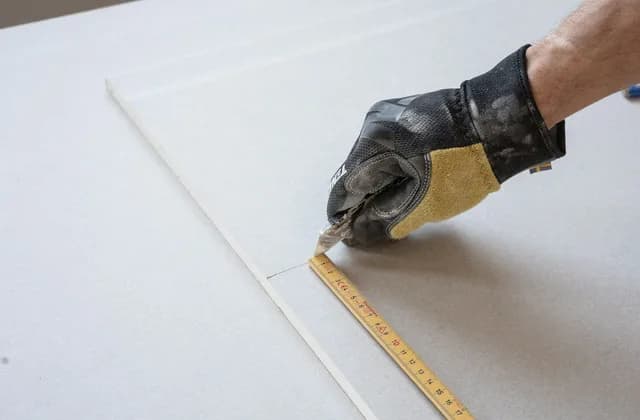
Drywall repair looks simple until you try it. A door handle goes through the wall, a brown stain spreads across the ceiling after a leak, or screw heads start popping through the paint. Or you are planning something bigger: a new partition, a finished basement, or a ceiling that has to come down after water damage. Either way, you need a drywall contractor who can hang the board, tape and finish it, and leave a wall that looks as if nothing happened.
This guide covers the United States and the United Kingdom, where the same material is usually called plasterboard. It explains repair versus new work, which board goes where, how to handle water damage, what to check before you hire, what sets the cost, and how the job runs from the first visit to the final coat.
Drywall repair or new walls: two different jobs
Repairs cover holes, cracks along joints and corners, nail or screw pops, dents, and patches damaged by water. A small hole can often take a patch, or a piece of new board held in place with repair clips. Larger damage means cutting back to the framing and fitting a new section. The real skill is blending the repair into the wall around it.
New work means hanging full sheets on studs or joists for a new wall, a ceiling or a converted space. The finishing steps are the same, but over a much larger area, and planning matters more: where the joints fall, how openings are framed, and which board each room needs.
Both follow the same sequence:
- Hang: fix the board to the framing, or fit the patch.
- Tape: cover the joints and corners with tape bedded in compound.
- Mud: apply joint compound in several coats, each wider and thinner than the last.
- Sand: smooth each coat once it is dry, without scuffing the paper face.
- Prime and paint: seal the new surface so it takes paint the same way as the rest of the wall.
Because compound needs drying time between coats, even a small repair usually takes more than one visit. If someone promises a finished, painted patch in a single short visit, ask how: a faster-setting compound is a fair answer, skipping coats is not.
Which board goes where
Not all board is the same. The right type depends on the room, and in some places on building codes. A good contractor will ask what the room is used for before quoting.
| Board type | Where it is used | Watch for |
|---|---|---|
| Standard | Walls and ceilings in dry rooms: bedrooms, living rooms, hallways. | Damaged quickly by water; not for bathrooms or damp areas. |
| Moisture-resistant | Bathrooms, kitchens and utility rooms. Often green. | Resists humidity but is not waterproof; ask what goes behind tiles in a shower. |
| Fire-rated (Type X in the US) | Where codes require fire resistance, for example between an attached garage and the house in the US. | Ask your contractor or building department where it is required in your home. |
| Patch or repair section | Holes and damaged areas in existing walls. | Must match the thickness of the existing board, or the patch will sit proud or sunken. |
Water damage: fix the cause before the wall
A stained or sagging ceiling is often the most visible part of a leak, not the problem itself. Patching over damp board means the stain comes back, the tape lifts, and mould can grow out of sight behind the new surface.
The right order is: stop the leak, let the area dry fully, cut out the damaged board, check the framing and insulation, and only then close the wall. A careful drywall contractor will ask whether the leak has been fixed and may refuse to close up wet framing. That is a good sign, not an inconvenience.
Check for mould before closing the wall: once the damaged board is out, look at the back of the remaining board, the framing and the insulation. If mould covers more than a small area, get specialist advice before anyone hangs new board over it.
Drywall installation cost and repair cost: what sets the price
A per-square-foot figure found online cannot price your job. Two contractors can quote very differently for the same room depending on what each one includes. Some price new work by area, per square foot in the US or per square metre in the UK. Small repairs are often priced per job, because the visits and drying time cost the same whether the hole is small or medium. These are the items that move the number:
- Size of the repair or area: one patch, several patches, a full wall or a whole room.
- Ceiling or wall: ceilings are slower and harder work, and the board is heavier overhead.
- Height and access: stairwells, high or sloped ceilings, and anything that needs scaffolding or tall ladders.
- Board type: moisture-resistant or fire-rated board where the room needs it.
- Texture matching: recreating an existing textured finish so the repair does not stand out.
- Finish quality: how smooth the surface has to be, especially under strong side light or a glossy paint.
- Number of visits: drying time between coats sets how many trips the job needs.
- Painting: whether priming and painting are included, and whether the whole wall needs repainting to hide the patch.
- Preparation and cleanup: moving furniture, dust protection, and removing old board.
Texture and finish
Matching an existing texture is a skill of its own, and sometimes the honest answer is that the whole wall or ceiling needs re-texturing to look even. If your home is older, ask whether existing textured coatings should be tested before anyone sands them, and follow local guidance on that. For smooth walls, agree how smooth “finished” means before work starts, because more coats and more sanding mean more time.
Posting a job on Hirovo is free. Describe the repair or the new wall, add photos and rough measurements, choose your area, and drywall contractors nearby can apply or message you in the app. You compare them and decide.
Post a free job →How to hire a drywall contractor
In the US
Licensing for drywall work varies by state, so check what your state and city require, and ask the contractor directly which licence they hold. New walls may need a permit depending on the scope of the job. Check with your local building department, and agree in writing who applies for the permit and arranges any inspection.
In the UK
You will usually be looking for a dryliner, who hangs and joints plasterboard, or a plasterer, who may also skim the board for a smooth finish. Ask for a written quote and for proof of public liability insurance, in case the work damages something in your home. If the drylining is part of a bigger alteration, ask your local authority whether any approval is needed.
Checks for both countries
- Photos of similar work: ideally close-ups of finished walls in side light, where poor joints show.
- A written estimate that lists the area, the board type, the level of finish, cleanup, and whether painting is included.
- Dust control: sanding makes fine dust; ask how rooms, floors and vents will be protected.
- Warranty: what happens if cracks, tape lifts or nail pops appear in the months after the job.
If the patch is only one part of a larger project, read how to hire a contractor. If someone else will paint the finished wall, see how to hire a painter.
How the job runs: visit, quote, work, sign-off
- Visit or photos: the contractor sees the damage, measures, and asks about leaks and room use.
- Written estimate: scope, board, finish, number of visits, painting and cleanup.
- Preparation: furniture moved, floors covered, doorways and vents sealed against dust.
- Hanging and finishing: board, tape and coats of compound over several visits.
- Inspection: look at the wall with a lamp held close before the final coat of paint.
- Invoice and warranty: keep both, together with photos of the finished work.
Questions to ask a drywall contractor
- Will you patch the area or replace a whole section, and why?
- Which board will you use in this room?
- How many visits do you expect, and what happens on each one?
- Can you match the existing texture, or will the whole surface need redoing?
- Is priming and painting included?
- How will you control dust, and who removes the old board?
- Do I need a permit or any approval, and who arranges it?
- What does your warranty cover if cracks or nail pops come back?
Using a free Hirovo job post
Posting a job on Hirovo is free. Describe the damage or the new wall, add photos, choose your area, and drywall contractors nearby can apply or message you. Hirovo is a global platform and the number of contractors registered in the US and UK is still small, so use it alongside other ways of finding local tradespeople. Hirovo does not verify the people who reply and is not a party to the work, so run the checks above on anyone who responds.
In short
Decide whether you need a repair or new work, and fix any leak before the wall is closed. Make sure each room gets the right board. Ask for a written estimate that lists the area, board, finish, visits, cleanup and painting. In the US, check licensing and permits locally; in the UK, ask for a written quote and public liability insurance. Allow time for the compound to dry, and inspect the finish in side light before you pay.