
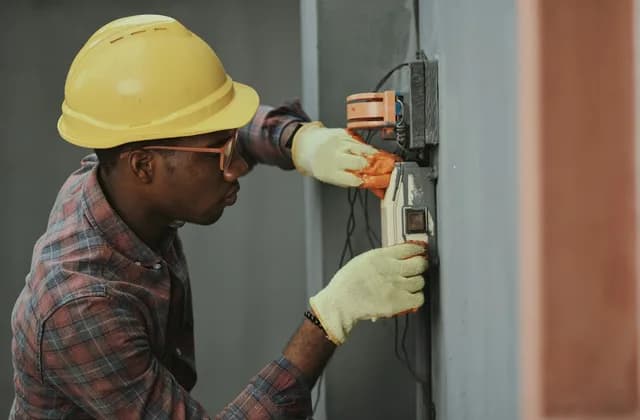
Electrician jobs in South Africa come in more shapes than most adverts admit. A Joburg contractor wants “installation electrician, own tools, CoC experience”. A factory in Durban wants a “qualified electrician, trade tested, three-phase fault-finding, standby”. A small solar and backup-power company in Cape Town wants “electrician for inverter and battery installs, must be able to sign off”. All three are electrician jobs, and they are asking for three different things.
The key to reading them is to separate two ideas that people on site often mix up. The trade test makes you a qualified artisan electrician. Registration under the Electrical Installation Regulations, 2009 decides whether you may sign a Certificate of Compliance (CoC). This guide explains both, the kinds of work available, what employers check, and how to use a free Hirovo profile to find work near you.
How to become an electrician in South Africa: the trade test and Red Seal
Electrician is a listed trade, and the recognised qualification at the end of the road is the trade test. Most electricians get there in one of three ways:
- Apprenticeship or learnership. You work for an employer under a contract, with structured workplace experience, while you complete trade theory. SETAs fund and register many of these; for electricians the relevant ones are usually merSETA (manufacturing, engineering and related), EWSETA (energy and water) and, on building sites, CETA.
- TVET college first. Many people complete the electrical engineering N1 to N3 subjects at a public TVET college, then look for the workplace experience needed to qualify. The theory on its own does not make you an electrician; the workplace hours do.
- Recognition of prior learning (RPL). If you have worked for years as an electrician’s assistant, you may be able to have that experience assessed and go to the trade test that way. Keep payslips, letters from supervisors and a record of the work you did.
The trade test itself is a practical and theory assessment at an accredited trade test centre. The national system sits with the Quality Council for Trades and Occupations (QCTO) and the National Artisan Moderation Body (NAMB), and INDLELA in Olifantsfontein is the best-known government centre. Passing gives you the trade certificate that people call Red Seal. Ask the SETA or the centre about current entry requirements and booking before you pay anyone to “help” you with the process.
Registration categories: who may sign a Certificate of Compliance
The Electrical Installation Regulations, 2009, made under the Occupational Health and Safety Act, say that only a registered person may issue a CoC for an electrical installation, and that the work must be done by or under the control of a registered electrical contractor. Registration is with the Department of Employment and Labour. There are three categories:
| Category | What it broadly covers | What employers use it for |
|---|---|---|
| Electrical tester for single phase | Testing and certifying single-phase installations. | Houses, townhouses, small flats and CoCs for property sales. |
| Installation electrician | Single-phase and three-phase installations, excluding specialised installations. | Shops, offices, blocks of flats, light industrial and most contracting firms. |
| Master installation electrician | All installations, including specialised ones such as hazardous locations. | Mines, plants, fuel stations and firms that need a senior person to sign everything. |
Each category has its own route. It generally involves your trade qualification, passing exams on the wiring code, SANS 10142-1, and a practical assessment of installation and testing, with more experience needed for the higher categories. The details change from time to time, so read them on the Department’s pages or ask at a labour centre rather than trusting an old WhatsApp message.
Why it matters for your career: a qualified electrician who cannot sign is useful, but a qualified electrician who can sign a CoC is who the contractor actually needs on a sale inspection, an extension or an inverter install. Adverts that say “must be registered” or “CoC experience” mean this.
What a CoC is, and why employers care
A Certificate of Compliance confirms that an electrical installation was inspected and tested and complies with the wiring code at the time it was issued. It comes with a test report. CoCs are needed after new installations and after additions or alterations, and they come up constantly when houses are sold, because sale agreements and conveyancers usually ask for one.
Because the registered person signs personally, a CoC is also a legal risk. Signing for work you did not properly inspect, or for another person’s installation you never tested, can have serious consequences if there is a fire or injury later. Good employers will not ask you to do that; if one does, that tells you something about the job.
Types of electrician jobs in South Africa
Domestic installation and maintenance
Fault-finding, adding plugs and lights, replacing distribution boards, geyser circuits, stoves and compliance inspections for property sales. It is local work around Gauteng, the Western Cape and KwaZulu-Natal suburbs, and it depends on customer skills as much as technical skill. Many domestic electricians eventually work for themselves, which means registering as an electrical contractor.
Backup power, inverters and solar
Load shedding turned inverters, batteries and rooftop solar into a large part of domestic and small-business electrical work. Installers need the AC side done and certified properly, changeover and earthing done right, and, for grid-tied systems, the municipality’s embedded generation process followed. If this interests you, the dedicated solar installer guide in this series covers the extra training and checks.
Construction and contracting
New housing developments, shopping centres, schools and offices. Work comes in projects, often through contractors and labour brokers, with site inductions and the Construction Regulations, 2014, applied on site. Expect early starts, travel between sites and gaps between projects.
Industrial, mining and facilities
Factories, mines, hospitals, shopping centres and municipalities need electricians for maintenance, motor control, three-phase fault-finding and standby. This is where the installation electrician and master installation electrician categories, plus experience with PLCs and motor control centres, are most valuable. Mining work has its own additional safety training and medical fitness requirements.
Create a free Hirovo profile, add electrical work to your skills and set your area. When someone near you posts a job, you can apply or message them directly in the app.
Create a free profile →What employers check before hiring an electrician
Expect a serious employer to ask for most of the following. Having them ready, scanned on your phone, makes you faster to hire.
| Document or skill | Why they ask |
|---|---|
| ID document or valid work permit | Required to employ you and register you for UIF and tax. |
| Trade test certificate (Red Seal) | Proof that you are a qualified artisan. |
| Registration as a single-phase tester, installation or master electrician | Decides whether you may sign CoCs on their jobs. |
| Matric or N-certificates | Some employers use them to shortlist, especially for learnerships. |
| Driver’s licence, often Code 8 (B) | Many jobs involve driving a company bakkie between sites. |
| References from previous employers or supervisors | The easiest way for them to check your work and reliability. |
| Own hand tools and a working tester | Common for domestic and small-contractor work; ask what is supplied. |
Your rights as an employed electrician
If you are employed rather than self-employed, the Basic Conditions of Employment Act covers working hours, overtime, leave and payslips, and the National Minimum Wage Act sets the floor for pay; the national minimum wage is reviewed every year and usually changes from 1 March, so check the current figure with the Department of Employment and Labour. Your employer must register you for UIF and is covered by COIDA for injuries at work. In some parts of the electrical and engineering industries a bargaining council agreement sets minimum rates and conditions, so ask whether one applies.
Under the Occupational Health and Safety Act, the employer must provide a safe workplace and the protective equipment the work needs, and you may refuse to work on a live installation in unsafe conditions. If you are dismissed unfairly or not paid, the CCMA is the free route for most disputes.
Working for yourself: registering as an electrical contractor
Many electricians start taking private jobs on weekends and eventually go out on their own. Once you do installation work for customers under your own name, the regulations expect that work to be done by or under a registered electrical contractor, and the contractor needs a registered person in the right category to sign the CoCs. Registration as a contractor is also done with the Department of Employment and Labour; check the current requirements before you advertise.
Running your own business also means things an employer used to handle: quoting in writing, invoicing, keeping records of every CoC and test report you issue, public liability cover, tax registration with SARS, and, if you take on an assistant, registering as an employer for UIF and COIDA and paying at least the national minimum wage. It is more work, but it is also where experienced electricians have the most control over their income.
Customers are also getting better at checking. More and more of them ask for your registration category, the name of the registered contractor, and a written, itemised quote before they let you open the DB board. Having those answers ready, without hesitation, wins work.
Finding electrician jobs on Hirovo
Hirovo is new in South Africa, so there are not many local posts yet. That is also the honest reason to set up a profile early: when households, landlords and small businesses near you do post, the people with a clear profile are the ones they message first.
- Make a free profile and add electrical work as a skill. If you also do solar or inverter installs, add that too.
- Set your area, such as Soweto, Tshwane, Durban North or Gqeberha, so local posts reach you.
- Say what you can sign off. “Qualified electrician, installation electrician registration, CoCs for sales” tells a customer far more than “all electrical work”.
- Message clearly. Ask about the job, the address area and when they need it, and give a written quote.
Hirovo does not vet workers or check trade certificates or registration, and customers are told to check for themselves. Being ready to show your certificate and registration number when asked is what sets you apart.
Before you apply: ID or work permit ready · trade certificate scanned, if you have it · registration category and number, if you are registered · a short list of recent jobs with a reference · clear about whether you can sign a CoC · your area set on your Hirovo profile.
In short
The trade test makes you a qualified electrician; registration as a single-phase tester, installation electrician or master installation electrician decides whether you may sign a Certificate of Compliance. Read every advert for which of the two it wants. Build your route through an apprenticeship, a learnership or RPL, keep proof of your experience, know your rights under the BCEA and OHSA, and make a free Hirovo profile so local customers can find you as the platform grows in South Africa.