
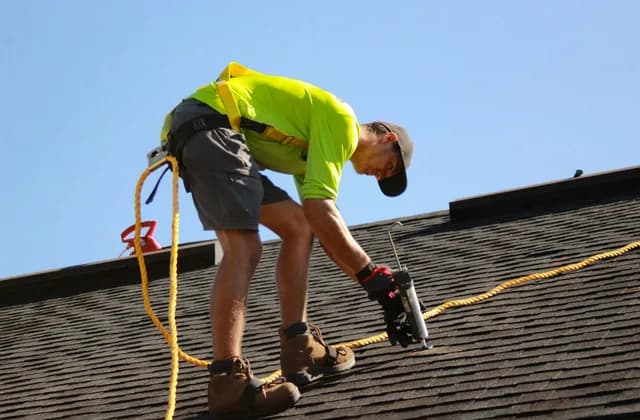
If you are working out how to hire a roofer, you are probably looking at a leak, a missing tile or an old roof that has started to worry you. Roofing is one of the easiest trades to oversell. You cannot easily climb up and check what you are told, and a rushed decision after a storm can cost more than the damage itself.
This guide covers the United States and the United Kingdom. It starts with the difference between a repair and a re-roof, then explains what sets the price, which licences, insurance and permits to check in each country, how warranties work, the scams to watch for, and the questions to ask before anyone goes up a ladder.
Repair or re-roof: what kind of roofing job you have
The material and the size of the job decide who you need and what paperwork follows. Match the job first, then the contractor.
| Job | Who to hire | What to check first |
|---|---|---|
| Slipped tiles or shingles, small leak, cracked flashing | A roofer for a repair | Photos of the damage, a written price and how they will reach the roof safely. |
| Full re-roof: asphalt shingles, tile or slate | A roofing contractor or roofing company | US: license, insurance and permit. UK: Building Regulations route, and consent for listed or conservation-area homes. |
| Flat roof or metal roof | A roofer who installs that system regularly | Recent jobs on the same material and the manufacturer’s warranty terms. |
| Gutters, downpipes, fascias | A roofer or a gutter specialist | Whether the roof edge or flashing is the real cause of the overflow. |
| Old fibre cement or corrugated sheets | An asbestos specialist | Testing before work, and a contractor qualified for asbestos removal. |
Roof repair cost: what sets the price
A per-square-foot figure from a calculator tells you little about your roof. Two houses on the same street can need very different work, and much of the cost sits in things you cannot see from the ground. These are the items that move the number:
- Size and pitch: a steep roof is slower and needs more safety equipment.
- Access and scaffolding: height, a narrow side path, a conservatory or a busy street below.
- Material: asphalt shingles, metal, slate, clay or concrete tile, or a flat roof system.
- Tear-off: how many old layers have to be stripped and taken away.
- What lies underneath: rotten decking, battens or rafters only show once the covering is off.
- Flashing and gutters: chimneys, valleys, skylights and roof edges add time.
- Urgency: an emergency call-out or a tarp in the rain is priced differently from planned work.
Get two or three written quotes against the same scope. Ask each roofer how they will price hidden damage to the decking, so a low quote does not grow once the old roof is off.
How to hire a roofer in the United States
License and insurance
Roofing licenses vary by state and sometimes by city or county. Ask for the license number and check it on the licensing board’s website, not just on a business card. Then ask for certificates of general liability insurance and workers’ compensation insurance, sent directly by the insurer or agent. Roofing is dangerous work. If an uninsured worker is injured on your property, the claim can end up with you.
Permits
A re-roof usually needs a building permit, and many places also inspect the work. A good contractor pulls the permit in their own name and tells you when the inspection is. If a roofer asks you to apply for the permit yourself, ask why.
Manufacturer warranty vs workmanship warranty
A manufacturer warranty covers the material. A workmanship warranty covers the installation. You want both in writing, with their length, what voids them and whether they transfer to a buyer. A verbal promise of “lifetime” cover is worth nothing.
Storm chasers and insurance claims
After hail or high winds, door-to-door crews arrive offering free inspections. Do not sign on the doorstep. Read every page, and be careful with any document that hands your insurance claim to the contractor or lets them negotiate with your insurer. Call your insurer first. The FTC’s Cooling-Off Rule may give you a short window to cancel some sales made at your home, so ask before you sign.
Posting a job on Hirovo is free. Describe the problem, add photos taken safely from the ground, choose your area, and roofers nearby can apply or message you in the app. You compare them and decide who comes to inspect.
Post a free job →How to hire a roofer in the UK
No licence, so check other things
Anyone can call themselves a roofer in the UK. Look for membership of a trade association and for TrustMark, the government-endorsed quality scheme. Ask for public liability insurance and check the dates cover your job. Ask for addresses of recent roofs you can look at from the street.
Building Regulations
Small repairs normally fall outside Building Regulations, but larger re-roofing can fall under them, for example when a significant part of the roof is renewed or the new covering is heavier than the old one. A roofer registered with a competent person scheme can self-certify the work. Otherwise, building control at your local council has to be involved. If you are unsure, ask building control before work starts.
Listed buildings and conservation areas
If your home is listed, changing the roof covering may need listed building consent. In a conservation area, a change of material can need planning permission. Check with the council first. Replacing slate with a cheaper product without consent can leave you paying to put it back.
Cold-callers and your rights
A stranger who “noticed some loose tiles” while passing is a known scam. Do not let them up the ladder. If you sign a contract at home, you usually have 14 days to cancel. Under the Consumer Rights Act 2015, the work must be done with reasonable care and skill.
Safety: scaffolding, falls and asbestos
Fall protection is the roofer’s responsibility, not yours. Ask how they will work safely: scaffolding, edge protection or a mobile platform. A roofer who plans to work off a ladder on a large job is cutting corners. Do not go up yourself to inspect. Old roof sheets on garages and outbuildings can contain asbestos and must be handled by a specialist.
Questions to ask a roofing contractor
- Can you show me photos of the damage you found?
- Is this a repair or does it need a re-roof, and why?
- US: what is your license number, and who pulls the permit?
- UK: can you self-certify this under Building Regulations?
- Can I see your insurance certificates?
- How will you price rotten decking or battens if you find them?
- Who does the work: your own crew or a subcontractor?
- What warranties do I get, in writing, and how long do they last?
- How do you protect the garden, gutters and windows, and who clears the waste?
How hiring a roofer works, step by step
- Inspection: the roofer checks the roof and the loft or attic and shows you photos.
- Written quote: scope, material, scaffolding, waste, start date and how hidden damage is priced.
- Agreement: sign only after reading it. Pay a deposit only for materials ordered for your job.
- The work: agree any extra in writing before it is done.
- Sign-off: check the result, get the invoice, warranties and any permit or completion certificate, then pay the balance.
For a larger project, our guide on how to hire a contractor covers contracts and stage payments in more detail.
Red flag: a roofer who wants most of the money up front, pressures you to sign today, or will only take cash with no invoice. A fair deposit covers materials ordered for your job, not the whole roof.
Using a free Hirovo job post to find a roofer
Posting a job on Hirovo is free. Describe the problem, choose the trade and your area, and roofers nearby can apply or message you. Hirovo is a global platform and the number of roofers registered in the US and UK is still small, so use it alongside the other ways you find local tradespeople. You decide whom to invite for an inspection. Hirovo does not verify the people who reply and is not a party to the work, so run the checks in this guide on anyone who responds.
In short
Work out whether you need a repair or a re-roof, and get two or three written quotes for the same scope. Price depends on size, pitch, access, material, tear-off, hidden damage, flashing and urgency. In the US, check the license, insurance, permit and both warranties, and do not sign anything a storm chaser hands you. In the UK, check insurance, TrustMark or trade-association membership and the Building Regulations route, and turn away cold-callers. Leave asbestos to a specialist, agree extras in writing, and pay the balance once the work is done.