
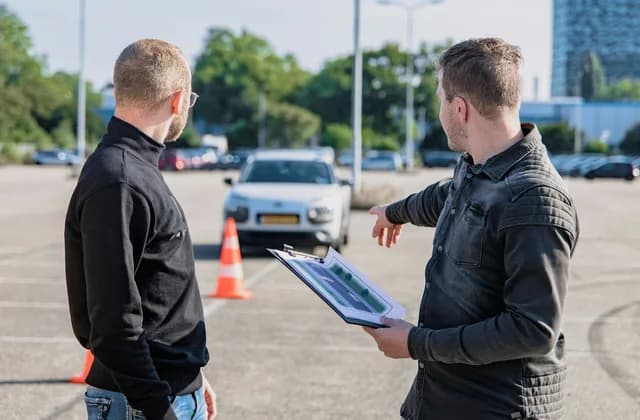
Most people in Benin City start this search the same way. They type “driving school in Benin City”, get a list of names, and then cannot tell what actually separates one from the next. Others already drive a little — a cousin taught them on an estate road — and what they really want is a driving instructor who will sit beside them for a few hours until Ring Road stops feeling like a test they are failing.
This guide is for you if you live in Oredo and you are trying to work out three things: whether a driving school or a private driving instructor fits your situation, what the licence process actually expects from you, and what makes one quote higher than another without anyone quoting you a price here. It also covers the part almost no generic guide covers — what driving in Benin City specifically asks of a new driver.
What driving in Benin City actually asks of you
A driver who learned on an empty road can pass the practical and still freeze at the first busy junction. Oredo is the centre of Benin City, and the traffic here has a particular character. Make sure your lessons include these, and say so before you start.
- Roundabouts, not just junctions. Ring Road and the roads radiating out of it mean you will be reading a multi-lane roundabout on your way to almost anywhere. Choosing your lane before you enter, holding it all the way round, and reading which car is about to peel off are learned skills. A learner who only practises on side streets gets none of this.
- Okada and keke density. You will be sharing the road with a heavy volume of motorcycles and tricycles, and they appear from angles a new driver does not expect — down your inside, across your bonnet, through a gap you did not think was a gap. This is a mirror habit and a speed habit, not a rule you can memorise. Ask your instructor to take you out at a busy hour on purpose.
- Rainy season water and potholes. When the rains come, a road you know changes shape. Standing water hides depth and hides the edge of the tarmac, and a pothole you cannot see is the one that takes a tyre or a rim. The lesson is simple and hard to obey: you slow down for water you cannot see the bottom of, every single time.
- Unlit roads at night. Many roads carry little or no street lighting. At night you are judging distance from other people’s headlamps, and pedestrians, handcarts and unlit motorcycles show up late. Night driving deserves its own lesson rather than something you pick up later on your own.
- Tight compounds and reversing. Most of the actual stress of daily driving is parking: reversing through a narrow gate, turning in a compound with a wall on one side, holding the car on a slope. Ask for this explicitly. It is the part schools rush and the part you will do twice a day for the rest of your life.
Driving school or private driving instructor: which one fits you
The measured searches in Benin City are almost all about schools, but that is habit, not always the right answer. Here is the honest split.
A school usually wins when you have never driven at all and need a structured programme rather than loose hours, and it wins outright when you need the accredited certificate for your licence. A school has a syllabus, a set of cars and a paper trail.
A private driving instructor usually wins when you already drive a little and need hours and confidence rather than a beginner course; when you want to learn in your own car, which is the car you will actually be driving; when you need lessons at hours a school does not run, such as early mornings before work or at night; and when you want one-to-one attention instead of sharing a car and the driving time with other learners.
For a lot of people in Oredo the sensible answer is both: the school for the certificate and the formal grounding, a private instructor for the hours that turn a pass into an actual driver.
| Where you are now | School or private instructor | Agree before the first lesson | What moves the cost |
|---|---|---|---|
| Never driven at all | School — you need a structured programme | Whose car, manual or automatic, how often lessons run | Number of hours; transmission type |
| Drove years ago, now rusty | Private instructor — hours, not a beginner course | An honest assessment drive first, then a plan | How many hours you actually need after the assessment |
| You already own the car | Private instructor, taught in your own car | Who is responsible for damage, and whether your insurance covers a learner | Your car versus the instructor’s car; who insures it |
| You need the licence certificate | Accredited school — a private instructor alone will not cover this | That the school is accredited, and what it does and does not handle for you | Whether licence processing is bundled or billed separately |
| You want night and wet-road practice | Either, but it must be asked for explicitly | That lessons include unlit roads and rainy-season conditions | Night and bad-weather sessions are usually priced apart |
| You live outside central Oredo | Either — but ask where lessons start | Whether you are picked up or you come to them | Pick-up distance and travel time |
The licence: why an accredited driving school still matters
This is the section people skip and then regret. In Nigeria the driver’s licence is issued through the Federal Road Safety Corps working with the state Vehicle Inspection Office and the state licensing centre. The process expects you to come with a certificate from an accredited driving school. That single word is why “my uncle taught me” and “a private instructor taught me” can both end the same way: you can drive, and you cannot finish the paperwork.
So before you pay anyone anything, ask two questions and get clear answers. First, to the school: are you accredited, and what exactly do you issue at the end? Second, to a private instructor: are you attached to an accredited school, or is this teaching only? Neither answer is wrong — an instructor who says “I teach, you handle the licence separately” is being straight with you. What costs you money is assuming.
Requirements, steps and the documents you must present do change. Confirm the current position with the FRSC and with the licensing centre serving Benin City rather than with a forwarded message or an old blog post. Anyone who promises you a licence without you doing the test is not offering you a shortcut; they are offering you a problem.
Keep the teaching and the paperwork separate in your own head, and separate in whatever you agree. Write down what the lessons cover, what is included in the fee, and whether any licence processing is part of it or billed apart. If money for licence processing changes hands, ask for a receipt and ask who is actually doing the processing. A good instructor will have no problem with either question.
Say what you need in a few lines — a full beginner programme, refresher hours, lessons in your own car, or night and wet-road practice. You can see the driving instructors listed in Oredo on Hirovo and message them directly, then settle hours, car and price between you.
See driving instructors in Oredo →What a driving instructor in Oredo costs, and what moves the price
Cost is the other thing everybody searches for, and no honest page can give you one figure — quotes for the same words differ because the words are hiding different things. What you can do is understand the levers, then ask two or three providers to quote against the same description.
- How many hours. The single biggest lever. A short refresher and a full beginner programme are not the same product.
- Whose car, and who insures it. Learning in the instructor’s car means you are also paying for wear, fuel and their risk. Learning in yours removes that, but only if the responsibility question is settled in advance.
- Manual or automatic. Availability differs, and so does the number of hours a beginner needs.
- Licence processing bundled or separate. The most common reason two quotes look wildly different. Ask which one you are being quoted.
- Where lessons start. Lessons inside Oredo cost less in time than pick-up from further out, and travel time gets priced one way or another.
- Night and rainy-season sessions. These are often extra rather than standard. They are also the ones worth paying for.
- Vehicle class. Learning to drive a car and training for a truck or a commercial vehicle are different programmes with different equipment behind them.
You can also get a feel for what is active in the area from the Oredo page, or widen it to Edo State and Nigeria if you are willing to travel for the right teaching.
Before the first lesson, agree these in writing
- What the fee covers, and what it does not.
- Whose car is used, and who is responsible for damage.
- Manual or automatic, confirmed rather than assumed.
- Where each lesson starts and ends.
- Whether night driving and rainy-season driving are included.
- Whether the instructor or school is accredited, and what document you receive at the end.
- What happens if you miss a lesson, and how much notice is expected.
In short
Split the question in two and it becomes easy. The licence is a process run through the FRSC, the Vehicle Inspection Office and the state licensing centre, and it expects an accredited driving school certificate — confirm the current requirements directly with them. Driving, on the other hand, is a skill, and the fastest way to build it in Benin City is hours in real traffic: roundabouts, okada and keke around you, wet roads, unlit roads at night, and a tight compound gate at the end of it. A private driving instructor is often the better buy for that second part, especially if you are rusty or you already own the car. Ask what is included, agree it before the first lesson, and make sure the hard conditions are in the programme instead of waiting for you on a rainy night.