
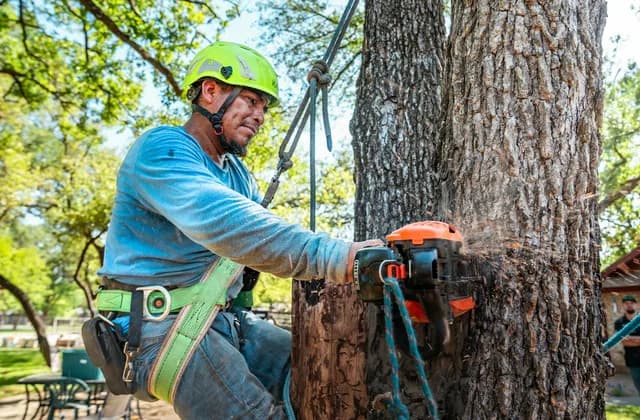
A branch is scraping the roof, a dead tree is leaning toward the fence, or a storm has left a limb hanging over the driveway. You want to know the tree trimming cost or tree removal cost, and whether the person offering a low price is safe to let near your home. Tree work is dangerous, and a bad cut can ruin a healthy tree or damage a property.
This guide covers the United States and the United Kingdom, where both the words and the rules differ. It explains trimming, removal and stump work, what sets the price, which credentials and insurance to ask for, which permissions to check first, and how to handle door-to-door offers after a storm.
Tree trimming, removal and stump work: three different jobs
In the US, people usually talk about a tree service, tree trimming and an arborist. In the UK, the same work is done by a tree surgeon, and trimming is often called pruning or crown work. Describe what you want to achieve, such as clearing a roof, letting in light or getting rid of a dead tree, and ask the professional to propose the method.
| Job | What it involves | What moves the price | Watch for |
|---|---|---|---|
| Trimming / pruning | Removing selected branches to clear a roof, reduce weight or take out dead wood. The tree stays. | Height, number of branches, climbing or lift access, debris removal. | Too much cut at once, and vague wording such as “tidy it up”. |
| Removal / felling | Taking the whole tree down, in one go if there is room, or piece by piece with ropes if there is not. | Size, condition, nearby buildings and lines, crane or rigging, crew size. | Permission checks, the stump left behind, and who takes the logs. |
| Stump grinding | A machine grinds the stump below ground level, leaving wood chips. | Stump size, gate width for the machine, buried pipes and cables, chip removal. | How deep the grind goes. Surface roots may stay. |
Say no to topping
Topping means cutting the main stems back to stubs to make a tree shorter. It can look like a quick, cheap fix, but it leaves large wounds, encourages weak regrowth and can shorten the tree’s life or make it more hazardous later. If someone offers to top your tree, ask about a proper crown reduction instead, or ask whether that tree should stay at all. Also ask whether climbing spikes will be used on a tree you are keeping, because they wound the trunk.
Tree trimming and removal cost: what sets the price
A per-tree or per-hour figure online cannot price your tree. The same height can be simple in an open yard and complicated beside a conservatory and a power line. These are the items that move the number:
- Size and species: height, spread and trunk width, plus how heavy and how hard the wood is.
- Condition: dead, decayed or storm-damaged trees may be unsafe to climb and can need different equipment.
- Location: what lies underneath, such as roofs, fences, glasshouses, roads or lines.
- Access: a narrow side gate or soft lawn can rule out machines and mean more carrying by hand.
- Equipment and crew: climbers, rigging, an aerial lift or a crane, and any traffic control.
- How it is priced: a fixed price for the job, or a day or hourly rate that can grow if the work overruns.
- Stump and debris: grinding, chipping, hauling away, and whether logs stay with you.
- Urgency: emergency callouts and busy periods after storms.
- Permissions: who prepares any application, and the wait it adds.
Comparing quotes
Ask each company to see the tree in person, or send clear photos from several angles if an early estimate is all you need. Get the scope in writing: which trees, exactly what will be done, stump or no stump, the clean-up, and whether the figure is fixed or an estimate. A much lower quote may simply leave out the stump, the clean-up or the insurance. Ask what is missing before you assume it is a bargain.
Posting a job on Hirovo is free. Add photos of the tree and what lies around it, say whether you want trimming, removal or stump work, choose your area, and tree workers nearby can apply or message you. You compare them and decide.
Post a job for free →How to hire a tree service safely: credentials and insurance
In the US, look for an ISA Certified Arborist. The credential comes from the International Society of Arboriculture and belongs to a person, not a company, so ask who holds it, whether they will assess your tree, and check their status with ISA. Licensing rules vary by state and city, so ask your local authority what applies. Ask for proof of general liability cover and workers’ compensation. Request the certificate from the insurer rather than accepting a photocopy, and ask your own home insurer what happens if an uninsured worker is hurt on your property.
In the UK, anyone can call themselves a tree surgeon, so the checks matter. The Arboricultural Association’s Arb Approved Contractor scheme is one strong signal, because member firms are assessed. Not every good firm belongs, so otherwise ask for a qualified tree surgeon and to see the chainsaw and climbing qualifications of the people doing the work. Ask for public liability insurance, and employer’s liability insurance if the firm has staff.
In both countries, ask how the work will be done. A proper crew has helmets, chainsaw protective clothing and rigging, and someone stays on the ground while a climber works. If branches are near an overhead line, do not let anyone start. Contact your electricity company first, because only properly authorised workers should go near live lines.
Permits and protected trees: check before work starts
United Kingdom
Contact your local council before any significant work. A Tree Preservation Order can mean you need the council’s consent, even to prune, and in a conservation area you generally must give the council notice before work begins. Exceptions are narrow, and the penalties can be serious, so ask the tree officer rather than assuming. Also check for nesting birds. Under the Wildlife and Countryside Act 1981, it is an offence to intentionally damage or destroy an active nest, so spring and summer work needs a careful look first. Bats are protected too, and an old tree can hide a roost.
United States
Rules are local. Ask your city or county whether you need a permit, particularly for large or heritage trees. Street trees may belong to the city even if they stand in front of your home. If you have an HOA, read its rules and get any approval in writing. For a tree on a shared boundary, talk to your neighbor before work starts, and ask a local authority or lawyer if you disagree. Before stump grinding, call 811 so buried utility lines can be marked.
After a storm: door-to-door offers and upfront payment
Storms bring out people knocking on doors with a chainsaw and a truck. Some are honest. Others have no insurance, no training and no plans to return. The pressure sounds the same: the tree could fall any minute, a discount ends today, or cash is needed now for equipment. Take a breath. Unless the tree is an immediate danger, you have time to check.
If a tree is on a house, on a line or blocking a road, keep everyone away and call the emergency services or your utility. Photograph the damage and call your home insurer before agreeing to major work, and ask what they need from you. Get a name, an address and an insurance certificate even for urgent jobs.
Warning signs: a demand for full payment upfront, cash only, no written quote, no business address, or an offer to “top” the tree. Walk away from any of them, however urgent it sounds.
From site visit to final invoice
- Site visit: walk around the tree together and point out anything you want protected, such as plants, paths or fences.
- Written quote: scope, method, stump, clean-up, price, deposit if any, and a rough date.
- Permissions: agree who checks and who applies. Keep the answer before any cutting starts.
- The day: move cars and furniture, keep children and pets indoors, and warn neighbors about noise and access.
- Final check: look over the tree, the ground, gutters and fences, and report damage straight away.
- Invoice: ask for an invoice showing the work done and the business details, then keep it with your permission papers.
Using a free Hirovo job post
Posting a job on Hirovo is free. Describe the tree, the work you want and what is nearby, choose your area, and tree workers can apply or message you. Hirovo is a global platform and the number of tree services registered in the US and UK is still small, so use it alongside other ways of finding local help. Hirovo does not verify the people who reply and is not a party to the work, so run the checks above on anyone who responds.
In short
Decide whether you need trimming, removal, stump work or a mix, and get written quotes for the same scope. Avoid topping. Ask for an ISA Certified Arborist in the US, or an Arb Approved Contractor or qualified tree surgeon in the UK, and ask for proof of insurance. Check with the local authority before cutting, watch for nesting birds in the UK, and do not pay the full price upfront to a stranger at your door after a storm.