
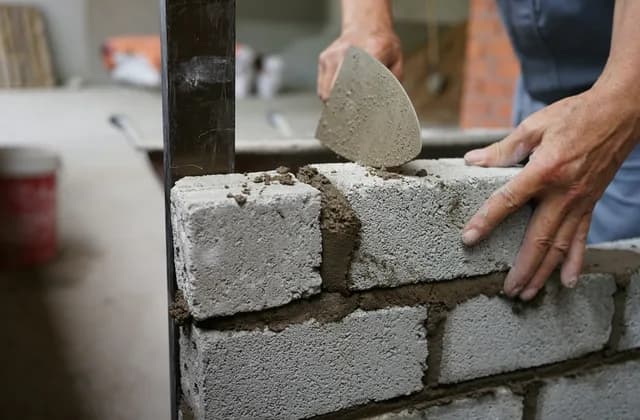
Bricklayer jobs in South Africa rarely say exactly what they want. One post asks for a “bricklayer with face brick experience, own tools, start Monday” in Midrand. Another wants a “brick and plaster team, labour only” for a housing development near Durban. A homeowner in Tshwane just wants “someone to rebuild the boundary wall that fell in the rain”. All three are bricklaying jobs, and each is judged on something different: finish, speed, or trust.
Most South African houses are built from masonry, so bricklayers are needed in every town, from new estates in Gauteng to extensions in Gqeberha and security walls in Pietermaritzburg. This guide explains the kinds of bricklaying work, how people learn the trade and get it on paper, the skills a builder tests you on, safety, how pay is set, and how to use a free Hirovo profile to find work near you.
Bricklayer jobs in South Africa: the kinds of work
| Kind of work | What you do | Who usually hires |
|---|---|---|
| New houses and complexes | Foundation brickwork, walls up to wall plate, openings, lintels, face brick or plaster brick. | Builders, developers and labour-only subcontract teams. |
| Extensions and alterations | Tying new walls into old ones, matching existing brick, forming new openings. | Small builders and homeowners. |
| Boundary and security walls | Footings, piers, walls to height, pillars for gates and palisade infill. | Homeowners, estates, body corporates, small contractors. |
| Commercial and civil | Block walls in warehouses and shops, manholes, plinths and structures to an engineer’s drawings. | Contractors on larger projects. |
| Repairs and maintenance | Rebuilding collapsed walls, cutting out cracked brickwork, re-pointing. | Homeowners, property managers, schools and churches. |
You will also meet different materials. Clay stock bricks are usually plastered. Face bricks stay exposed, so every joint shows and mortar smears are a real fault, not a cosmetic one. Cement blocks and maxi bricks are larger and faster to lay but heavier on your back. A bricklayer who can do all three, and knows the difference in how they are handled, is easier to place on any site.
How to become a bricklayer: from assistant to trade test
Bricklaying is still one of the trades where people start with no matric and work their way up. The usual path is general worker, then bricklayer’s assistant, then bricklayer. The assistant mixes mortar, which many sites still call daga, keeps the bricklayer supplied, builds up simple sections and learns to read the line. There are also formal routes that put paper behind the skill:
- Learnerships and skills programmes. CETA, the Construction Education and Training Authority, funds and accredits construction training. Contractors, training providers and some municipalities run bricklaying programmes that combine classroom time with site work.
- Apprenticeship and the trade test. Bricklaying is a recognised trade. After structured workplace experience, you sit a trade test at an accredited trade test centre. The national system sits with the Quality Council for Trades and Occupations (QCTO) and the National Artisan Moderation Body (NAMB). Passing gives you a trade certificate.
- Recognition of prior learning (RPL). If you have laid bricks for years without a certificate, ask a trade test centre or CETA whether your experience can be assessed so that you go to the trade test without starting from the beginning.
- TVET colleges. Public TVET colleges offer building and civil programmes. They give you theory and drawings, but the workplace hours are what make you a bricklayer, so ask which programme counts towards the trade and how you will get site experience.
Keep evidence as you go: payslips, letters from foremen, photos of walls you built with the date and suburb. That record is what RPL assessors, training providers and future employers ask for, and it is gone if you only kept it in your head.
Does the trade certificate matter?
On private houses and boundary walls, builders mostly hire on a trial wall and a reference. The certificate matters more with larger contractors, on public projects, for foreman and supervisor roles, and where a bargaining council agreement grades workers by qualification. It is also a strong answer when a customer asks “are you qualified?”, which happens more often than it used to.
What a builder tests you on: skills of a good bricklayer
Most builders will not read a long CV. They will watch you lay for twenty minutes. These are the things they look at:
- Plumb, level and line. Corners built true, courses dead level, and the face of the wall straight to the line. A wall that is out of plumb costs the plasterer and the tiler later.
- Setting out. Working from the building line, profiles and the drawing, getting openings and wall positions right the first time. Moving a wall after the slab is cast is expensive.
- Even gauge. Using a gauge rod so courses match heights on the drawing: window sills, lintels and wall plate all land where they should.
- Bonds. Stretcher bond for most modern walls; knowing English and Flemish bond helps with older face brick and repair work.
- Reinforcement and damp. Laying brickforce in the courses the specification asks for, fitting wall ties, and putting the damp proof course (DPC) at the right level, lapped and unbroken.
- Openings and lintels. Bearing lengths for precast lintels, keeping frames plumb, and not loading an opening before it can carry the weight.
- Clean work. On face brick, no smears, full joints and a consistent finish. Cleaning a stained face brick wall afterwards is slow and can damage it.
- Mortar. The mix the specification asks for, not the mix that is quicker. In hot, windy weather, wetting bricks where needed and keeping fresh work from drying out too fast.
The technical rules for walls, foundations and roofs sit in the National Building Regulations, with SANS 10400 as the standard that explains them; Part K deals with walls. The engineer and the builder set the specification, not you, but a bricklayer who understands why brickforce, DPC and lintels matter makes far fewer expensive mistakes and is trusted to work with less supervision.
The trial wall
Many builders ask a new bricklayer to build a corner or a short section before agreeing a rate. Arrive on time with your own trowel, spirit level, line and pins. Ask for the drawing or the height you are building to, check the mortar before you start, and work at the pace you can keep all day, not a show pace you cannot repeat. Clean your work as you go. A tidy, accurate corner at normal speed beats a fast wall that needs to come down.
Safety on brickwork
Construction sites are controlled by the Occupational Health and Safety Act and the Construction Regulations 2014. In practice, several of those rules reach you directly:
- Induction and PPE. A site induction before you start, and protective equipment such as a hard hat, safety boots, gloves and eye protection supplied free by the employer.
- Medical certificate of fitness. Construction workers need one, linked to the work they do. Many contractors arrange it.
- Working at height. Once walls pass shoulder height you work from trestles or scaffolding. Do not build off loose planks or stacked bricks. Scaffolding must be erected and inspected by competent people, and where you could fall the contractor needs a fall protection plan.
- Cement and skin. Wet cement and mortar are strongly alkaline and cause burns and dermatitis. Wear gloves, wash skin that gets splashed, and protect your eyes when mixing.
- Cutting. Cutting bricks and blocks with a grinder throws up dust that damages the lungs over time. Cut wet where possible, use a proper dust mask, eye and hearing protection.
- Trenches and heat. Foundation trenches can collapse; deep ones need support. On summer sites in Limpopo or the Northern Cape, water, shade and a hat are not optional.
- Your back. Bricks and blocks add up to many tonnes a week. Lift with your legs, keep loads close, and use the barrow.
Under the OHS Act you may refuse work that is clearly dangerous, such as building off an unsafe platform, and you must not be punished for raising a safety concern.
Create a free Hirovo profile, add bricklaying to your skills and set your area. When a builder or homeowner nearby posts a job, you can apply or message them directly in the app.
Create a free profile →What builders and customers check before hiring a bricklayer
Having these ready, with copies or scans on your phone, makes you faster to hire than someone who says “I will bring it tomorrow”.
| Document or proof | Why they ask |
|---|---|
| ID document or valid work permit | Needed to employ you and register you for UIF and tax. |
| Photos of your work, with dates and areas | The quickest way to show face brick, corners and boundary walls you built. |
| References: foremen or builders’ phone numbers | Builders trust other builders more than any certificate. |
| Trade certificate, if you have one | Proof that you are a qualified artisan bricklayer. |
| Medical certificate of fitness | Required for construction work under the Construction Regulations. |
| Working at heights certificate | Opens scaffold and upper-storey work. |
| Own hand tools | Trowels, spirit levels, line and pins, gauge rod, brick hammer and bolster. |
| Driver’s licence, often Code 8 (B) | Small builders often need someone to drive the bakkie to site. |
How bricklayer pay is set
Pay for bricklayers varies widely by region, contractor, project and experience, so treat any figure you hear on site as somebody else’s deal. What decides yours:
- Employed or subcontracted. An employee is paid a wage for the hours worked and has the protection of labour law. A labour-only subcontractor quotes for the work and carries the business risk.
- Day rate or price work. Price work, an agreed rate per thousand bricks or per square metre of wall, is common in housing. It rewards fast, accurate teams, but you lose when bricks do not arrive, the slab is late or it rains. Agree how the work is measured before you start.
- Face brick or plaster brick. Face brick is slower and less forgiving, and usually priced accordingly.
- Bargaining council agreements. In some regions a building industry bargaining council agreement sets minimum wages, grades and benefits for employers in its scope. Ask whether one covers the site.
- Rain days, travel and overtime. Ask what happens when it rains, whether transport or a living-out allowance is paid on far sites, and how overtime is recorded.
The national minimum wage is the floor for every employee, including those paid by output. It is reviewed every year and usually changes from 1 March, so check the current amount with the Department of Employment and Labour rather than trusting an old number.
Your rights as an employed bricklayer
If you are employed, the Basic Conditions of Employment Act covers hours, overtime, leave and payslips. Your employer must register you for UIF, deduct and pay contributions, and report injuries at work under COIDA. Construction work is often fixed-term, ending when the project ends; that is lawful, but you are an employee with full rights while it runs, and you should get the start date, pay, hours and the project or end date in writing.
If you are placed on site by a labour broker, you still have these rights, and in some cases the Labour Relations Act can make the client jointly responsible or treat you as its employee after a period. The details depend on your pay and situation, so ask the CCMA if something seems wrong. The CCMA does not charge workers to refer a dispute about unfair dismissal or unpaid wages.
Working for yourself: boundary walls, extensions and small builds
Many bricklayers start with weekend boundary walls and end up running a small team. That brings a different set of duties:
- Quote in writing. Say whether the price is labour only or supply and labour, what is included (footings, piers, plaster, clearing rubble), the payment schedule and the start date.
- Check approvals before you dig. Extensions need building plans approved by the municipality, and some boundary walls do too. Retaining walls and walls holding back soil usually need an engineer. Ask the customer to show you the approval rather than assuming.
- Deposits for materials. If you buy materials, agree a deposit that covers them and keep the slips. If the customer supplies, agree who is responsible for waste and breakages.
- Quality and the law. The Consumer Protection Act expects services to be done with reasonable care and skill; a wall that cracks because the footing was skipped comes back to you.
- Helpers. Once you pay a helper, you are an employer: register for UIF and COIDA, pay at least the national minimum wage, and keep records.
- Bigger work. If you build new houses as the builder, the home builder must be registered with the NHBRC. For public sector work, contractors are graded by the Construction Industry Development Board (CIDB).
Moving up on site
Experienced bricklayers who read drawings well, set out accurately and can keep a team working often move into foreman roles, and some later become site agents. Learning a second trade helps too: many bricklayers also plaster, and some move into tiling or paving. If wiring interests you more, see electrician jobs in South Africa for how that trade and its registration work.
Finding bricklayer jobs on Hirovo
Hirovo is a free jobs and local services marketplace. It is new in South Africa, so there are not many local posts yet, and it does not replace your network of builders and foremen. It is one more way for work to reach you: a homeowner in Soweto who needs a wall rebuilt, or a small builder in Bellville short of a bricklayer, can post a job and message the people nearby.
- Make a free profile and add bricklaying as a skill. If you also plaster or pave, add those.
- Set your area, for example Tembisa, Mitchells Plain, Umlazi or Polokwane, so local posts reach you.
- Be specific. “Bricklayer, eight years, face brick and boundary walls, own tools, can read plans” tells someone far more than “all building work”.
- Message clearly. Ask about the job, the area, the materials and when they need it, and give a written quote.
Hirovo does not vet workers or check trade certificates, and employers are told to check for themselves. Being ready to show photos, a reference and any certificate is what sets you apart. Never pay anyone to be given work.
Before your next bricklaying job:
- ID document or work permit, and a copy.
- Photos of recent work with dates and suburbs.
- Two foremen or builders who will take a call about you.
- Trowel, levels, line and pins, gauge rod, safety boots.
- Pay, rate and how price work is measured agreed in writing.
- Your area and skills set on your Hirovo profile.
In short
Bricklayer jobs in South Africa range from face brick houses to boundary walls and repairs, and most builders hire on a trial wall and a reference. Learn plumb, level, gauge and clean work first, then put paper behind it through a CETA learnership, an apprenticeship or RPL and the trade test. Work safely, know how your pay is calculated, especially on price work, get it in writing, and add a free Hirovo profile so local customers can find you as the platform grows in South Africa.